The Democracy We Practice vs. the Power We Need
Why Nigeria Needs Collective Intelligence
Every four years, Nigerians wake up early, join long queues under the scorching sun and cast their votes. We ink our thumbs, take our selfies and go home believing we have fulfilled our democratic duty. But what if I told you that this ritual, this singular act of voting, represents the greatest lie ever told about democracy?
The truth is stark and unsettling. Nigeria, like most nations claiming democratic governance, is not actually a democracy. We are a republic with democratic flavouring, a system designed not for the people to rule, but for the people to choose their rulers. And once we make that choice every four years, our power evaporates like morning dew under the harmattan sun.
You need to understand that democracy is not a word that arrived with ballot boxes. It comes from two Greek words: demos, meaning “the people,” and kratos, meaning “power” or “rule.” Literally translated, democracy means the people rule. Not the people vote. Not the people choose who rules them. The people themselves exercise power. It means the people don’t just pick who governs, they participate in how they are governed. Their knowledge, experience and judgment actively shape policy, not just on election day, but continuously. Athens understood this. Most modern states, including Nigeria, have quietly forgotten it.
When America’s founding fathers crafted their constitution in 1776, the word “democracy” appeared exactly zero times in their documents. This was not an oversight. Benjamin Rush explained it plainly in 1787- citizens possess power only on election day, after which “it is the property of their rulers.” They were designing a republic, a system where a small, educated elite would govern on behalf of the masses.
This model travelled across oceans and took root in African soil. When Nigeria gained independence in 1960, we inherited this same blueprint. We replaced colonial masters with our own elites, swapped British aristocrats for our university-educated few and called it democracy. 64 years later, we are still living inside this borrowed framework, wondering why it doesn’t fit.
Consider ancient Athens in 508 BCE. Before democracy, Athens was an unremarkable, middle-tier city-state among many. But when they expelled their tyrant and embraced true citizen power, everything changed. Within 150 years, Athens became the crown jewel of the Greek world, defeating the mighty Persian Empire and birthing philosophy, medicine and architectural marvels like the Parthenon. Their secret? Athenians didn’t just vote. They practised what we now call collective intelligence, the ability of a group to pool its knowledge, debate openly and act on shared decisions.
Seen through that lens, Athenians can be understood as exercising six functional capacities:
1. Observation: Citizens, officials and traders brought in information from across the Mediterranean about wars, trade and alliances, giving the city a wide field of vision even without modern bureaucracy or intelligence agencies.
2. Interpretation: In large assemblies and courts, diverse groups of citizens debated proposals and judged cases. This mass participation helped them process information and make decisions more effectively than any single group of experts.
3. Innovation: New ideas emerged from networks of citizens who competed with and built upon each other’s work, much like the artisans in our own Lagos markets who iterate (or copy, lol) and improve on each other’s designs.
4. Deliberation: Before decisions, Athenians debated openly, challenged ideas, discussed trade-offs. This wasn’t just a vote count, it was a rigorous examination of options and they deliberated until consensus emerged.
5. Action: Because citizens contributed to solutions, they were invested in implementing them, which is something we desperately lack when policies are handed down from Abuja without local input.
6. Memory: They conserved and passed on collective wisdom, building institutional knowledge across generations.
And this wasn’t just theory. In your lifetime, you had a realistic chance to serve on the Council of 500, the executive branch of the city chosen by lottery each year. Rich or poor, thousands of citizens gained hands-on governing experience solving problems, working with people different from them. The state covered your living costs during service. This was democracy as a constant learning process, a boot camp in citizenship. Yes, Athens excluded women, immigrants and slaves (a moral failure we must not repeat), but those 40,000 or so citizens who did participate wielded more power than any citizen body before or since.
Now compare this to Nigeria. We vote every four years, then watch helplessly as policies that affect our daily lives are decided by a small circle in Aso Rock or the National Assembly complex in Abuja. When communities in the Niger Delta complain about environmental degradation from oil extraction, their observations rarely inform national energy policy. When traders in Ariaria market develop innovative solutions to power and logistics challenges, these innovations don’t shape government infrastructure planning.
Our farmers in Plateau State understand water scarcity intimately, yet water management strategies come from technocrats who may never have set foot on a farm. Our youth in Lagos have firsthand experience with unemployment and hustle culture, yet economic policies are crafted by economists who studied abroad and returned with theories that don’t match our reality.
This is not a democracy. This is rule by representative proxy, where our power begins and ends at the polling station.
Some might ask, “Why not just let the experts handle it? Bring in PhD holders in economics, environmental science, and public policy to run things efficiently?”
Any Athenian would tell you why. Individual experts excel at well-defined problems with clear parameters. But our biggest challenges- climate change, insecurity, economic inequality, energy transition, are wickedly complex and constantly shifting. These are problems that defeat experts and algorithms working in isolation.
Consider the recent fuel subsidy removal in Nigeria. Economic experts argued it was necessary for fiscal sustainability. They had data, models and international precedents. But they couldn’t account for the lived experience of millions who would be devastated by the decision, couldn’t predict the cascading effects on transportation, food prices and small businesses, couldn’t design adequate palliatives because they didn’t understand how money actually flows through informal economies.
A collective intelligence approach would have pooled observations from transporters, market women, students and factory workers. It would have generated diverse predictions about impact. It would have innovated locally-appropriate solutions through deliberation. It would have created buy-in for implementation. Instead, we got expert decision-making followed by widespread suffering and protest.
The truth is that the transition to real democracy through collective intelligence won’t come from Abuja declarations or constitutional amendments. It will emerge from networks of successful initiatives that demonstrate a better way.
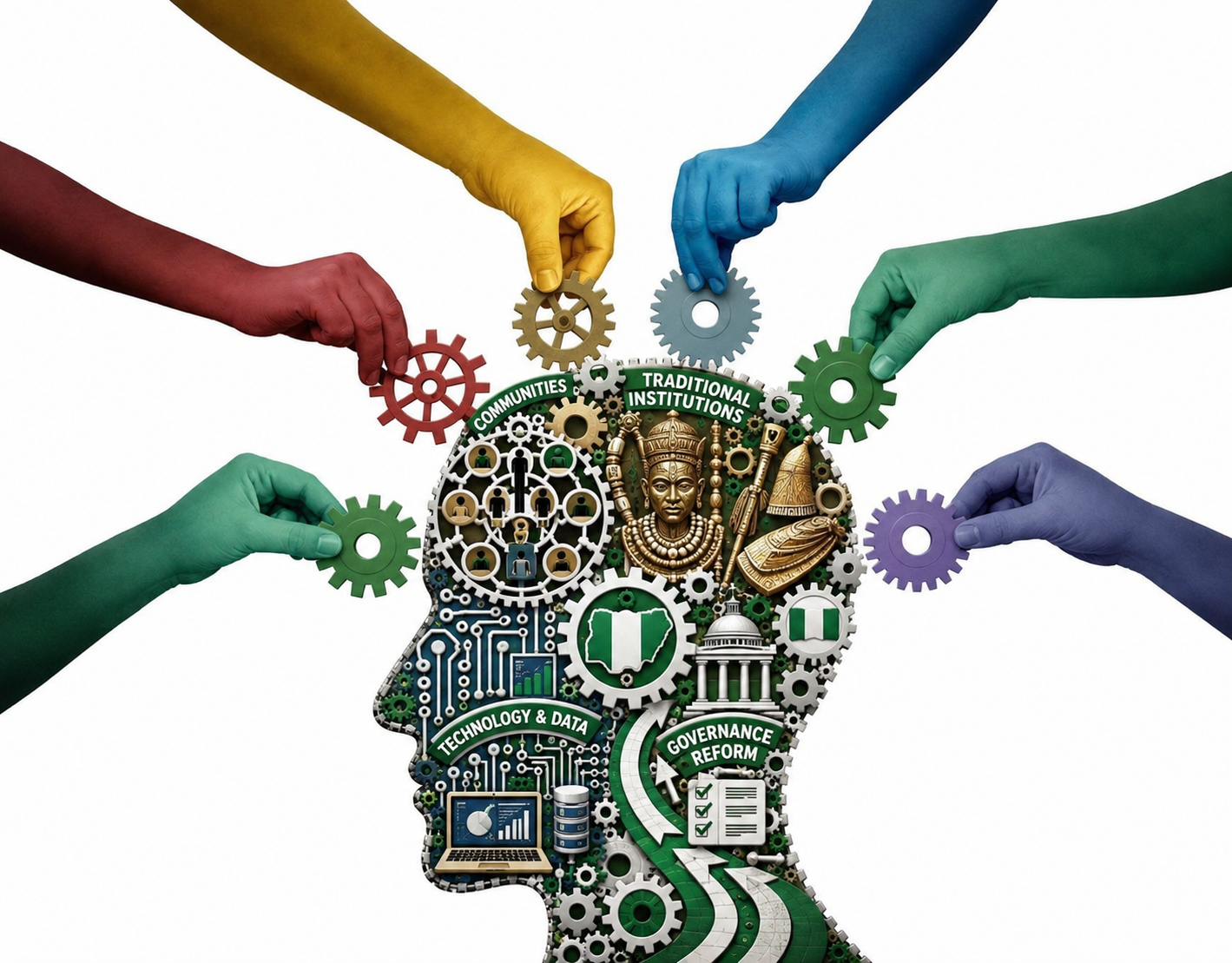
At the Community Level: In places like Makoko, the floating slum in Lagos, residents have already shown collective intelligence in action. In places like Makoko, residents have already shown collective intelligence in action. Largely abandoned by the government, they have driven and shaped innovations in housing, sanitation and education on water. What if we formalised and supported such processes? What if every local government had citizen assemblies that pooled community knowledge to solve local problems?
In Traditional Institutions: Many Nigerian communities never fully abandoned collective intelligence. Across our over 300 tribes and languages, there are countless examples of indigenous collective intelligence we’ve barely begun to study or celebrate. The Tiv age-grade systems that rotate leadership and responsibilities, the Efik Ekpe society’s consensus-building traditions, the Igbo umunna and umuada system, Yoruba egbe meetings and various Northern Nigerian council structures already practice aspects of collective deliberation. We don’t need to import foreign models wholesale, we need to recognise, strengthen and scale what already works in our culture.
In Technology and Data: Nigeria has Africa’s largest tech ecosystem, and the seeds of collective intelligence are already visible in it. BudgIT’s Tracka app allows citizens across Nigeria’s 774 local government areas to report and monitor government projects in their communities, from roads and schools to water supply and health centers, pooling grassroots observations into a national accountability layer. Budgit This is collective intelligence in practice. But it is only the beginning of what is possible. Nigeria already has the talent and the infrastructure to build these things. The question is whether we will redirect that innovation toward the urgent work of self-governance, or continue using it to solve every problem except the political ones.
In Governance Reform: Countries like Ireland and France are experimenting with citizen assemblies, with randomly selected groups given real power to deliberate on complex issues. Ireland used this model to address abortion rights and same-sex marriage, producing solutions that survived referendum votes. Nigeria could pilot similar approaches for contentious issues like resource control, restructuring, or constitutional reform.
I come to this conversation as someone who is deeply invested in social mobility, which is the ability of Nigerians, regardless of where they start, to rise and build better lives. In my view, social mobility is perhaps the most critical challenge we must solve in the next few decades. Not just because it’s morally right, but because our continent’s future depends on it.
Collective intelligence connects directly to this because social mobility dies in systems where a small elite controls all the decision-making. When only those who went to certain schools, come from certain families, or have certain connections can influence policy, the ladder gets pulled up behind them. The brilliant girl in a Sokoto village, the innovative mechanic in Aba, the visionary trader in Maiduguri, their talents are wasted because there’s no mechanism for their intelligence to inform how we govern ourselves.
But collective intelligence changes the equation. When we create systems that pool observations, predictions and innovations from everywhere, not just from Ikoyi and Maitama, we don’t just make better decisions. We fundamentally expand who can participate in shaping our future. We make social mobility structural rather than accidental.
We also cannot ignore women. Some interesting research from MIT shows that collective intelligence increases proportionally with the number of women involved. More women means better decisions. Yet Nigerian governance remains overwhelmingly male. True collective intelligence requires that we bring everyone to the table- women, youth, people with disabilities, the poor, religious minorities, everyone. This is not idealism, it’s pragmatism. When people come together and engage in genuine reasoning, extraordinary things happen. There are proven results to buttress this fact. The question is whether we will formalise and scale these successes or continue pretending that voting every four years constitutes democracy.
Democracy is in crisis globally, but especially in Nigeria, because it is not yet actually democracy. Our republic was designed to produce ruling elites, and ruling elites predictably produce decisions that favor people like them. We can keep what we’ve fought for; rule of law, freedom of conscience, universal suffrage. But I think that we must expand it to include the full range of capacities Athenian citizens exercised. We must reinvent our institutions to make collective intelligence possible at local, state and federal levels.
This won’t be easy. Politics never is. Power doesn’t surrender without a fight and Nigeria’s political elites have perfected the art of maintaining control while giving the appearance of democracy. But we have something they fear: numbers, diversity of experience and the desperation that comes from knowing the current system isn’t working.
The age of collective intelligence is coming, whether through intentional design or chaotic collapse. We can lead this transition or be swept along by it. We can build networks of citizen power from the bottom up, or we can wait for the next election cycles to disappoint us again.
Ancient Athens transformed from mediocrity to greatness through collective intelligence. Nigeria, with our 200 million people, our incredible diversity, our culture of community solidarity, our tech-savvy youth and our battle-tested resilience, can achieve something those ancient Greeks could only dream of.
But first, we must stop living the lie. We must recognise that democracy is not what we have, it’s what we must build together.
The question is not whether collective intelligence will come to Nigeria. The question is whether we will seize this moment to shape it, or watch from the sidelines as history happens to us once again. The societies that will thrive this century are those betting on collective intelligence and that can be us.