The Cost of Not Voting
About 2 months ago, the sporting world witnessed one of those moments that seem almost impossible outside the theatre of a marathon. The place was the city of glitz and glamour, Los Angeles. Two runners, men whose manila and caramel skins glistened under the morning sun, sprinted toward the finish line, lungs burning, arms pumping, legs stretching forward in desperation. Their chests crashed against the tape almost at the same time. At stake was glory—and $25,000 in prize money.
When the result appeared on the screen, the difference between the winner and the runner-up was 0.01 seconds. One hundredth of a second. That was all that separated triumph from defeat.
Now imagine if the winner of that race had been decided by an election. Yes, an election. It might surprise you to know that elections are often decided in very similar ways. What do you mean, you might ask. Hold my beer. Let’s talk about it.
Like marathons, elections begin crowded and noisy. Millions line up at the start. Contestants, with their high falutin manifestos promising change or trumpeting a new era. But by the time the race reaches the finish line—when the ballots are counted—the difference between victory and defeat can be astonishingly small.
Sometimes, the margin is not millions of votes.
Sometimes, it is thousands.
Sometimes. hundreds.
Sometimes just one.
And when people choose not to vote, those tiny margins become powerful enough to decide the future of entire nations.
The Power of a Few
Let’s take a trip to the Gold Coast, Ghana.
In the 2008 Ghanaian general election, the presidential race was decided by one of the narrowest margins in modern African politics. John Atta Mills defeated Nana Akufo-Addo with less than one point. Here is how their results stood after votes were counted:
Mills: 50.23%
Akufo-Addo: 49.77%
The difference was less than half a percentage point, only about 40,000 votes in a country of more than 20 million people. Forty thousand voters decided who would lead Ghana.
Most times numbers seem so ginormous if considered as a whole, but if we choose to look at it as part and not the whole, then we would see that the election was decided by one person and thirty nine thousand people like him who made the same decision to come out to vote. Or perhaps one person and thirty nine thousand plus others who decided not to vote.
Regardless, for the next four years, the destinies of about 20 million people would rest on the shoulders of a person, or a people’s indecision. This is the nature of elections.
Is this an African thing? This chest to the wire, this close call election scenario? I beg to differ. Pack your bags with me, let’s make a trip outside Africa. Europe has also seen elections decided by margins small enough to fit inside a living room.
In Finland, the presidency was once decided by two votes. Yes, two.
In the 1956 Finnish presidential election, the final vote in the electoral college looked like this:
Urho Kekkonen — 151 votes
Karl-August Fagerholm — 149 votes
All it needed was just two votes. No special people; just available people who cast their votes. It was their decisions that determined who would become president. If either of the two people had chosen differently, they could have changed the course of Finnish history.
Sometimes the cost of not voting is not just narrow margins. It is low participation that allows a small portion of the population to decide for everyone else.
The 2023 Nigerian Presidential Election as a Case Study
In the 2023 Nigerian presidential election, about 93 million Nigerians registered to vote. However, only around 25 million people actually voted. That means roughly one out of every four registered voters decided the presidency of Africa’s most populous country. We will talk about the unregistered voters on another day.
The winner, Bola Tinubu, secured about 8.7 million votes. In a nation of over 200 million people, fewer than nine million votes determined who would lead the country. What does this mean?
These numbers are not just numbers, they are writings on the wall, they tell a simple story. When people stay home on election day, smaller group decides the outcome, policies are shaped by fewer voices, leaders are chosen by narrower mandates.
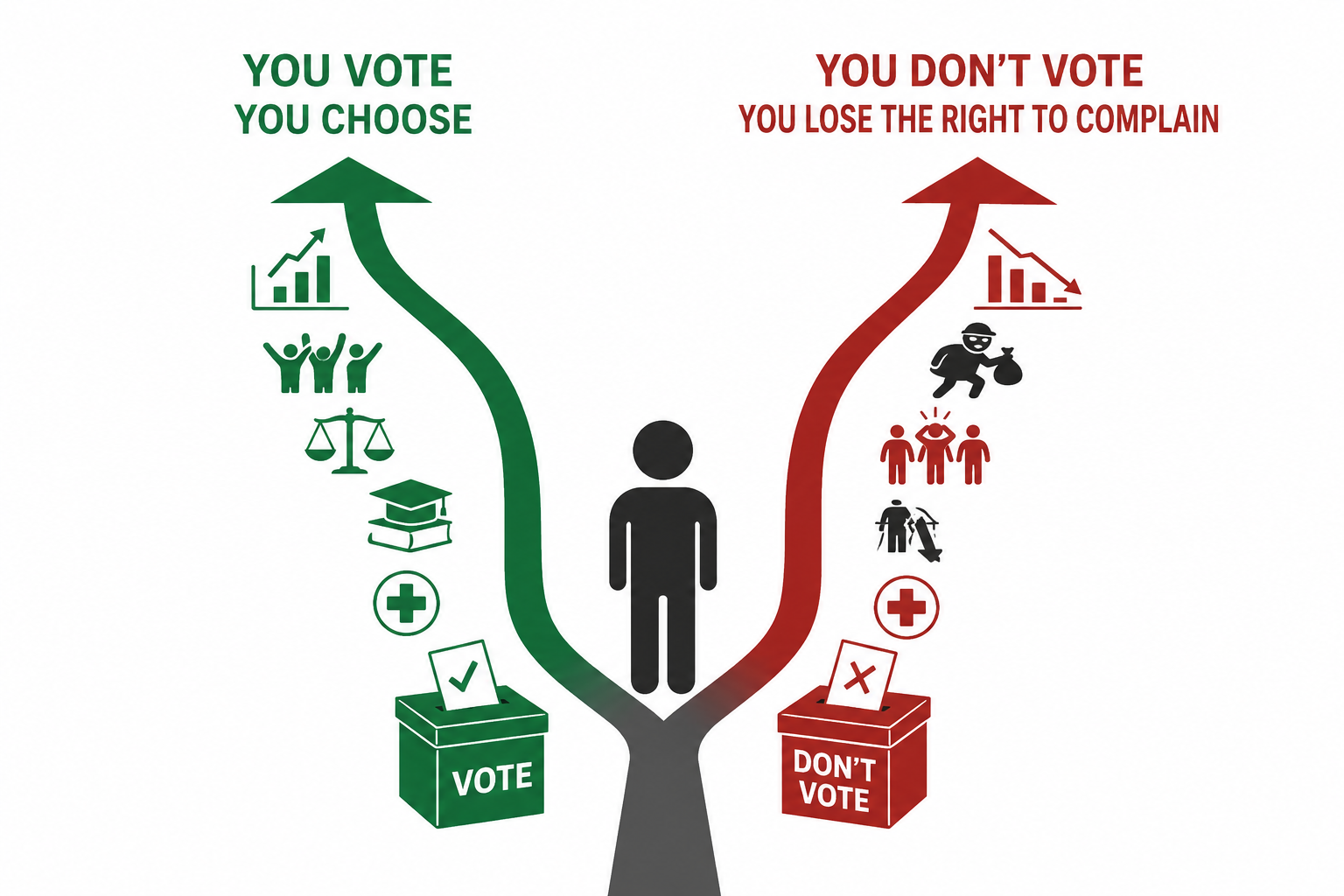
Interestingly here is what many non-voters or apathy allies (if that’s even a phrase) don’t know. Not voting does not remove you from politics It simply reduces your influence over the result. It places one in that liminal space between regret and wishes.
And here is why apathy is such a deadly thing, a cost that we might never be able to pay back. Elections are not the optional events we think they are, like every action, they come with complementary consequences. Elections, whether we vote in them or ignore them, determine decisions about fuel prices, education funding, job creation, security policies, health, and taxation, amongst other things. The leaders chosen at the ballot box, like the mythical spell which always comes to pass, make decisions that affect our everyday lives for years.
When citizens choose not to vote, they are not just skipping a civic duty. They are surrendering their influence over those decisions.
On your marks…
In a marathon, the difference between victory and defeat might be 0.01 seconds.
In elections, the difference might be a few thousand votes—sometimes even fewer, maybe one or two votes. And every person who decides not to vote moves that finish line a little closer for someone else. Because in democracy, the race is not won only by those who run. It is also shaped by those who choose not to show up at the starting line.
If you still think the prices of things are currently high, there is still hope that they can come down (even if in Nigeria, they rarely do). However, the costs incurred at elections we ignored, are sometimes the ones that go up and never come down.
We cannot change history, but perhaps, we can change the future simply by choosing to act. So dear reader, are you ready to be at the starting line in 2027? On your marks, get ready, vote.